

By Dr Alex Antoniou
On 4 Dec this year, my first monograph, Roman Priests from Republic to Empire, will be published by Oxford University Press. In a nutshell, the book challenges preconceived notions of the worth and status of Roman priests from Rome’s mythical and legendary past through to the early second century CE. Rather than rehash the book’s aims or abstract, in this blog thought I’d give you a glimpse of the kinds of things that the book explores by extracting, from the 120+ priests studied in the volume, just four: Claudia the Vestal, L. Caecilius Metellus the pontifex maximus, L. Volusius Saturninus the augur, and Domitian the pontifex maximus and head of all of Rome’s religious practices.
Claudia
Belonging to a renowned patrician family, Claudia held the most important religious office for a republican woman: she was one of Rome’s six Vestal Virgins. As a Vestal, Claudia was entitled to a level of public prominence and status unrivalled by most women, but it came at the expense of her perpetual virginity, and the ever-prevalent risk of being buried alive, if Rome perceived a threat to the pax deorum (‘the peace of the gods’). Claudia, however, appears to have used her public status for the benefit of her family. In 143 BCE, when her father sought to undertake an unauthorized triumph through the city, Claudia protected him when a hostile tribune of the plebs attempted to drag him from his chariot, presumably by standing between her father and the tribune. The relevance of Claudia’s actions is how she prevented this action from occurring, and what this means for the virtues she held and displayed as a priestess. Most scholars consider that Claudia, and therefore all other Vestals, possessed sacrosanctitas, a type of inviolable sanctity that meant that her body was protected from insult or injury. I’m not the first to recognise that none of our ancient sources ascribe sacrosanctitas to Claudia, and indeed many – like Cicero and Suetonius – talk of Claudia only when trying to recount the famous superbia (‘arrogance’) ascribed to the whole of the Claudian gens. Nonetheless, writers from Cicero onwards all ascribe the lesser virtue of sanctitas (‘sanctity’) to the Vestals, and consider it be one of the core virtues of these priestesses. What interests me is the possibility that Claudia, whether by intention or by accident, radically redefined the nature of her sanctity when she stood before the hostile tribune. It is possible that Claudia chose to actively weaponize her sanctity in a way that appeared very much like sacrosanctitas, and that in so doing, forever redefined the virtues to be ascribed to this priesthood.
L. Caecilius Metellus
L. Caecilius Metellus, pontifex maximus (‘chief priest’) of the mid-third century BCE, is perhaps best known for having plunged into the burning Temple of Vesta in the Roman forum, risking life and limb to rescue the sacra Vestalia (‘the sacred objects of Vesta’). What is so fundamentally interesting to me about the narrative of Metellus is how malleable the story was, and the extent to the story of his bravery endured. For Ovid, the story became a way of prefiguring the role and importance of Augustus. In the footsteps of Metellus, Augustus as pontifex maximus was charged with a sacred mission from Vesta herself to preserve Roman religious practices, chiefly the Vestal Virgins and their sacred objects. By contrast, for later imperial writers, Metellus’ story became one of divine punishment. Despite his bravery in rescuing some of the most sacred of Rome’s religious objects, in entering a space forbidden to men and rescuing objects that all men were forbidden to touch, Vesta nonetheless punished Metellus for his deeds. From Seneca the Elder and Pliny the Elder onwards, Metellus is blinded as punishment for looking upon Vesta’s secrets (and several centuries later, is said to have even lost an arm, for touching them). These stories are perhaps even more unique when we consider that, as far as our evidence suggests, this narrative was not recounted by Metellus’ own son in his funeral elegy for his father in the mid-third century bce. His son stressed instead that his father sought to be a leading solider, the best orator, the bravest commander, to have enjoyed the greatest honour, be uppermost in wisdom, the greatest senator, be wealthy by worthy mens, to leave behind many children, and to be the most distinguished man. Being a priest doesn’t seem to come into the picture. The fundamental question is why? Was being a priest not seen as being worthwhile in the mid-third century? Or did Romans lack the vocabulary for talking about the virtues of holding such an office?
L. Volusius Saturninus
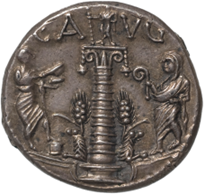
RRC 242/1 (reverse) Kunsthistorisches Museum, ID116395
Dying at an impressive 93 years of age, L. Volusius Saturninus was honoured by the senate, at the behest of the emperor Nero, with nine statues in his honour. What is remarkable about the way in which the senate chose to honour Saturninus is that these statues depicted Saturninus in the guise of one the different roles he had held during his lifetime. He was depicted ‘as augur’ in the Regia in the Roman forum, ‘in triumph’ in a bronze statue in the forum of Augustus and in two statues in the temple of the divine Augustus, ‘as consul’ in one statue in the temple of the divine Julius, one on the Palatine Hill, and one in the area of the Temple of Apollo, ‘on horseback’ in a statue near the Rostra, and depicted on the curule chair of the magistrates in the Theatre of Pompey. What is remarkable about this, for me, is not only the extent to which the senate could divide and pigeonhole Saturninus’ long life into the various roles in which he performed, but also that the senate felt it to be worthwhile to depict each of Saturninus unique roles. It is likely that Saturninus’ statue ‘as augur’ depicted him capite uelato – that is with the fold of his toga across his head – and holding the distinctive lituus – the curved augural wand associated with the office. This pose can potentially be seen in the figure on the far right of the pictured coin, in which an augur is depicted, probably in the form of a statue. This pose is immediately recognisable and distinctive, posing questions of the extent of his public visibility in Rome, both as an augur whilst alive, and also as an augur now deceased.
Domitian
The final priest I wish to consider here is Domitian as pontifex maximus, and, in effect, now the foremost authority on all of Rome’s religious practices. Of all the emperors of the first-century CE, it is perhaps Domitian that gained the most notoriety for his actions performed whilst a priest. Indeed, for many authors living through Domitian’s reign (Juvenal, Pliny the Younger, and potentially Statius), Domitian’s actions as chief of the pontiffs became a fundamental vehicle through which they illustrated, and came to terms with, Domitian’s autocracy. For Pliny the Younger, Domitian is not only incompetent but a dangerous hypocrite, endangering the relationship between men and the gods by accusing the chief Vestal Virgin of sexual impropriety when it he himself who had been sleeping with his own family members. Pliny describes Domitian as pontifex maximus as a conspicuous tyrant and master, and as contagious and polluting to the perpetually chaste and pure Vestal Virgins. Similarly for Juvenal, Domitian is an incompetent pontifex maximus, willing to gorge his interminable hunger and greed on a prodigally sized fish, rather than being capable of realising the fish for what it actually is, a prodigy from the gods that they were desperately unhappy with their chief priest. For these men, Domitian as chief priest is indicative of everything wrong with his repugnant autocracy.
Hopefully this small snapshot has whetted your appetite for thinking more about Roman priests.